Is It Correct to Say ‘more better’?
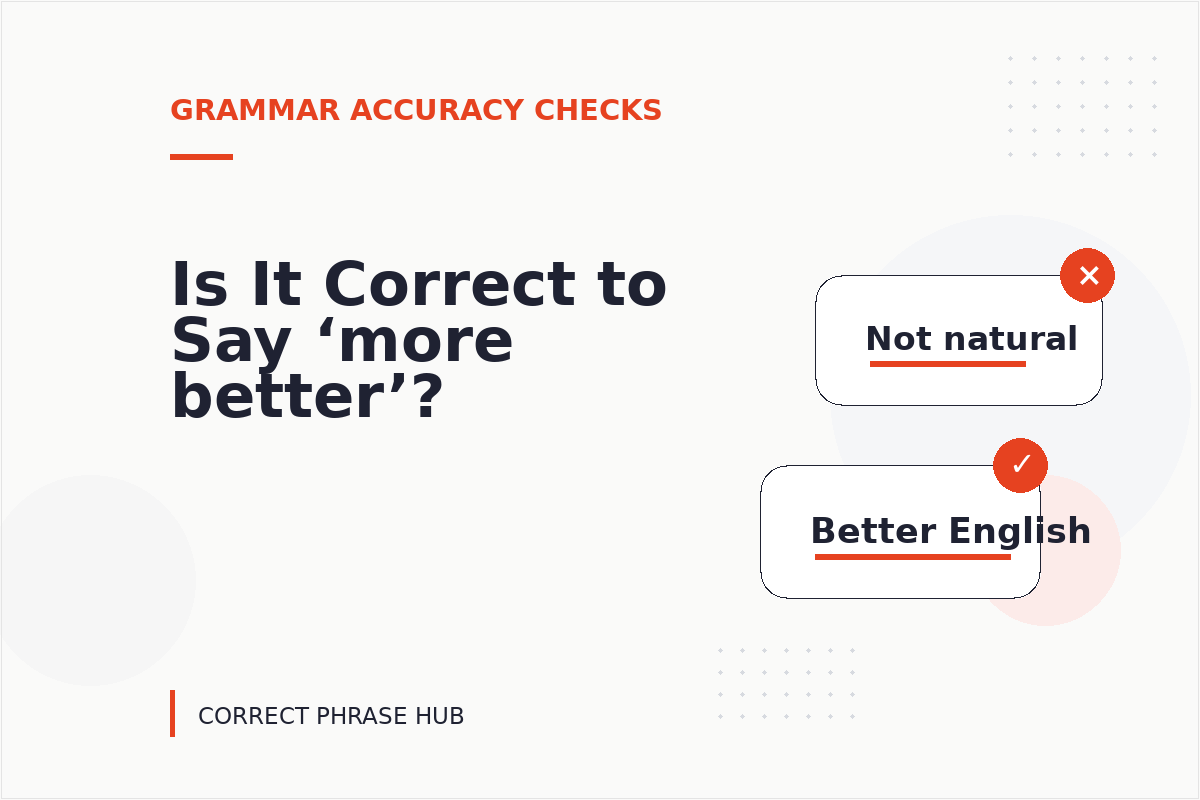
No, it is not correct to say “more better.” This is a common grammar mistake. “Better” is already the comparative form of “good,” so adding “more” is redundant and ungrammatical. The correct form is simply “better.”
Quick Answer
Do not use “more better.” Use “better” alone when comparing two things. If you need to emphasize a comparison, use “much better” or “far better” instead.
Why “More Better” Is Wrong
In English, adjectives have specific comparative forms. For short adjectives like “good,” the comparative is “better,” not “more good.” Adding “more” to “better” creates a double comparative, which is a grammatical error. Think of it like saying “more bigger” or “more faster”—it simply does not work in standard English.
The Rule for Comparatives
Here is the basic rule:
- One-syllable adjectives: add “-er” (e.g., tall → taller)
- Two-syllable adjectives ending in -y: change -y to -ier (e.g., happy → happier)
- Adjectives with two or more syllables: use “more” (e.g., beautiful → more beautiful)
- Irregular adjectives: use the special form (e.g., good → better, bad → worse)
“Good” is an irregular adjective, so its comparative is “better.” You never need “more” with it.
Formal vs. Informal Context
“More better” is considered incorrect in both formal and informal English. In casual conversation, some native speakers might say it as a joke or to mimic childlike speech, but it is never standard. In formal writing, such as emails, reports, or academic work, using “more better” will make you look unprofessional. Always use “better” or a stronger alternative like “far better” or “much better.”
Email Context
In professional emails, clarity and correctness matter. For example:
- Incorrect: “This proposal is more better than the last one.”
- Correct: “This proposal is better than the last one.”
- Stronger: “This proposal is much better than the last one.”
Conversation Context
In everyday speech, the same rule applies. Saying “more better” can confuse listeners or make you sound unsure. Stick with “better” for clear communication.
Comparison Table: “Better” vs. “More Better”
| Expression | Correct? | Usage | Example |
|---|---|---|---|
| Better | Yes | Standard comparative | “This coffee is better than that one.” |
| More better | No | Grammatical error | “This coffee is more better.” (wrong) |
| Much better | Yes | Emphasized comparative | “This coffee is much better.” |
| Far better | Yes | Stronger emphasis | “This coffee is far better.” |
| A lot better | Yes | Informal emphasis | “This coffee is a lot better.” |
Natural Examples
Here are examples of how “better” is used naturally in different situations:
- “I think the blue shirt looks better on you than the red one.”
- “Her English is better now after practicing every day.”
- “This restaurant is better than the one we went to last week.”
- “The new software is far better for managing projects.”
- “I feel much better after getting some rest.”
Common Mistakes
Here are typical errors learners make with “more better”:
- Mistake: “This solution is more better.”
Fix: “This solution is better.” - Mistake: “She is more better at math than me.”
Fix: “She is better at math than me.” - Mistake: “I need a more better phone.”
Fix: “I need a better phone.” - Mistake: “This is more better than nothing.”
Fix: “This is better than nothing.”
Better Alternatives
If you want to emphasize that something is significantly better, use these alternatives instead of “more better”:
- Much better – Use for a clear improvement. Example: “The revised draft is much better.”
- Far better – Use for a strong difference. Example: “This approach is far better for long-term results.”
- A lot better – Informal but common. Example: “I feel a lot better today.”
- Significantly better – Formal and precise. Example: “The new design is significantly better.”
- Vastly better – Emphatic. Example: “Her performance was vastly better this time.”
When to Use “Better”
Use “better” whenever you are comparing two things and one is of higher quality, more suitable, or more effective. It works in all contexts: casual conversation, professional emails, academic writing, and creative work. For example:
- “I think this plan is better.”
- “Which movie is better, the original or the sequel?”
- “Your suggestion is better than mine.”
Mini Practice Section
Test your understanding with these four questions. Choose the correct option.
Question 1
Which sentence is correct?
A. “This book is more better than that one.”
B. “This book is better than that one.”
Answer: B. “Better” is the correct comparative form.
Question 2
Fill in the blank: “Her cooking is ______ than mine.”
A. more better
B. better
Answer: B. Use “better” alone.
Question 3
How can you emphasize that something is much improved?
A. “It is more better now.”
B. “It is much better now.”
Answer: B. “Much better” is correct for emphasis.
Question 4
Which is the best choice for a formal email?
A. “This option is more better.”
B. “This option is far better.”
Answer: B. “Far better” is formal and correct.
FAQ
1. Is “more better” ever acceptable?
No, “more better” is never grammatically correct in standard English. It is a double comparative and should always be avoided. Some people use it in very informal or humorous speech, but it is not proper English.
2. Can I say “more good” instead?
No, “more good” is also incorrect. The comparative of “good” is “better.” Use “better” for comparisons. For example, say “This is better” not “This is more good.”
3. What is the difference between “better” and “best”?
“Better” is the comparative form, used when comparing two things. “Best” is the superlative form, used when comparing three or more things. For example: “This is better than that” (two items) vs. “This is the best of all” (three or more).
4. How can I avoid making this mistake?
Remember that “better” already means “more good.” If you feel the need to add emphasis, use “much better” or “far better.” Practice by writing sentences with “better” and checking for the word “more” before it. Over time, it will become natural.
For more help with common grammar questions, visit our Grammar Accuracy Checks section. If you have other questions, feel free to contact us. You can also read our Editorial Policy to understand how we create content. For general information, check our FAQ page.