Is It Correct to Say ‘I am having a question’?
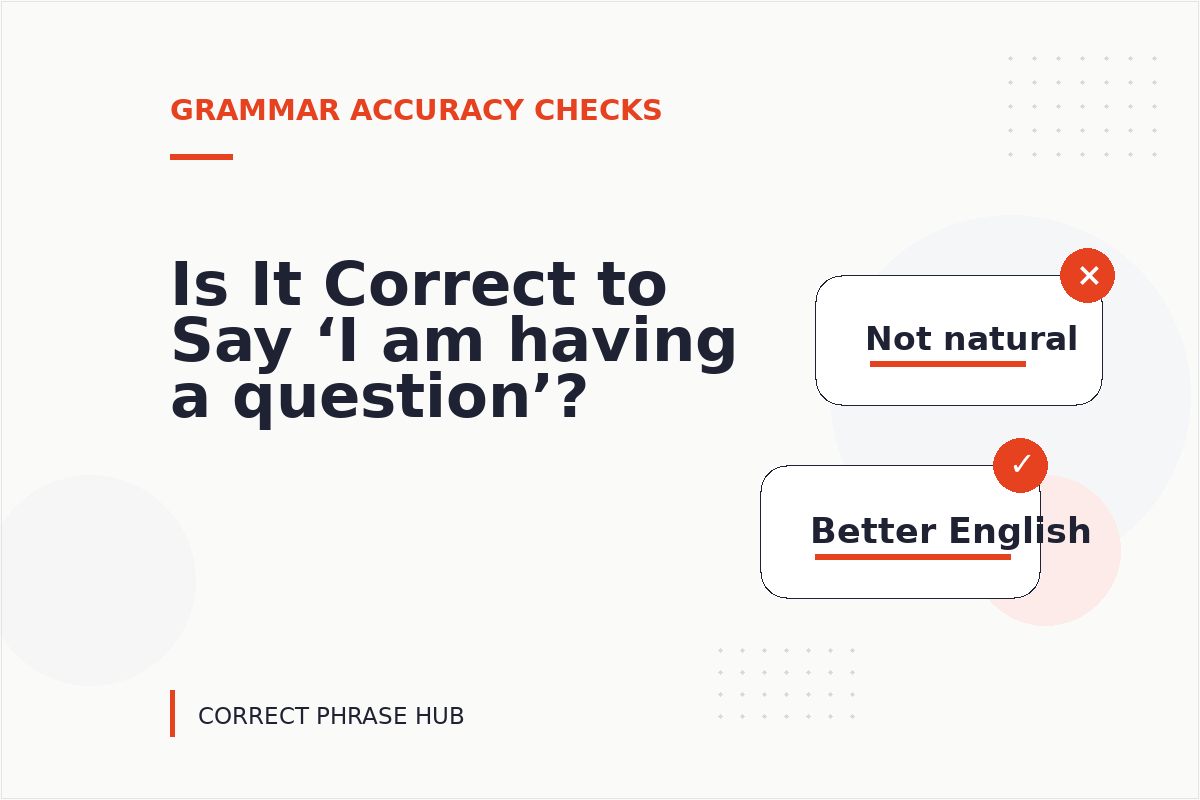
No, it is not correct to say “I am having a question” in standard English. The correct phrase is “I have a question.” The verb “have” is a stative verb when it means “to possess” or “to own,” and stative verbs are not typically used in the continuous (progressive) tense. Saying “I am having a question” is a common mistake among learners, but it sounds unnatural to native speakers. The simple present tense “I have” is the right choice for expressing that you possess a question or need to ask something.
Quick Answer
Use “I have a question” in all situations—whether you are speaking in a casual conversation, writing an email, or asking in a formal meeting. Avoid “I am having a question” because it incorrectly treats “have” as an action verb. The only time you can use “having” with “question” is in very specific contexts, such as “We are having a question-and-answer session,” where “having” refers to organizing or hosting an event, not possessing a question.
Why “I Am Having a Question” Is Incorrect
In English, verbs are divided into two main types: action verbs and stative verbs. Action verbs describe activities or processes (e.g., run, eat, write), and they can be used in continuous tenses (e.g., “I am running”). Stative verbs describe states, conditions, or possession (e.g., know, believe, own, have), and they are rarely used in continuous tenses. “Have” is a stative verb when it means “to possess” or “to hold.” Therefore, “I am having a question” is grammatically incorrect because it uses a stative verb in the continuous form.
This mistake often happens because learners translate directly from languages where the continuous form is used for possession. For example, in Spanish, “Estoy teniendo una pregunta” might seem logical, but in English, it is not acceptable. The correct equivalent is simply “I have a question.”
When “Having” Can Be Used with “Question”
There is one exception where “having” and “question” can appear together. When “have” is used as an action verb meaning “to organize,” “to host,” or “to experience,” the continuous form is possible. For example:
- “We are having a question-and-answer session after the lecture.” (organizing an event)
- “They are having a debate about the new policy.” (hosting an event)
- “I am having trouble with this question.” (experiencing difficulty)
In these cases, “having” is an action verb, not a stative verb. But when you simply want to say you possess a question to ask, always use “I have a question.”
Comparison Table: “I Have a Question” vs. “I Am Having a Question”
| Phrase | Correct? | Context | Example |
|---|---|---|---|
| I have a question | Yes | All situations (formal, informal, spoken, written) | “I have a question about the homework.” |
| I am having a question | No | Never correct for possession | “I am having a question” (incorrect) |
| We are having a Q&A session | Yes | Organizing an event | “We are having a question session tomorrow.” |
| I am having trouble with this question | Yes | Experiencing difficulty | “I am having trouble understanding this question.” |
Natural Examples
Here are examples of how native speakers naturally use “I have a question” in different contexts:
- In a classroom: “Excuse me, professor. I have a question about the assignment due date.”
- In a meeting: “Before we move on, I have a question about the budget forecast.”
- In an email: “Dear Support Team, I have a question regarding my account settings.”
- In casual conversation: “Hey, I have a question for you. Do you like pizza?”
- In a formal presentation: “If anyone has a question, please raise your hand.”
Common Mistakes
Learners often make these errors when trying to express that they have a question. Avoid them:
- Incorrect: “I am having a question about the report.”
Correct: “I have a question about the report.” - Incorrect: “She is having a question for the teacher.”
Correct: “She has a question for the teacher.” - Incorrect: “Are you having any questions?”
Correct: “Do you have any questions?” - Incorrect: “I am not having any questions right now.”
Correct: “I don’t have any questions right now.”
Better Alternatives and When to Use Them
If you want to vary your language or sound more natural, here are some alternatives to “I have a question,” along with when to use them:
- “I’d like to ask something.” – Polite and slightly formal. Good for meetings or when speaking to a superior.
- “Can I ask you something?” – Informal and friendly. Perfect for casual conversations with friends or colleagues.
- “May I ask a question?” – Very formal and respectful. Use in formal presentations, interviews, or with authority figures.
- “I was wondering about something.” – Soft and indirect. Useful when you want to sound less direct or more polite.
- “Could you clarify something for me?” – Professional and clear. Ideal for emails or work discussions.
Remember, “I have a question” is always correct and works in any situation. These alternatives are just options for variety or tone adjustment.
Mini Practice Section
Test your understanding with these four questions. Choose the correct option for each.
Question 1
Which sentence is correct?
A. I am having a question about the schedule.
B. I have a question about the schedule.
Answer: B. “I have a question” is the correct form.
Question 2
Fill in the blank: “Excuse me, ______ a question about the homework.”
A. I am having
B. I have
Answer: B. “I have” is correct.
Question 3
Which sentence is correct?
A. We are having a question-and-answer session tomorrow.
B. We are having a question tomorrow.
Answer: A. “Having a question-and-answer session” is correct because it refers to organizing an event. Option B is incorrect because it implies possessing a question in the continuous form.
Question 4
Choose the natural way to ask in a meeting:
A. I am having a question for the team.
B. I have a question for the team.
Answer: B. “I have a question” is natural and correct.
Frequently Asked Questions (FAQ)
1. Is “I am having a question” ever correct in English?
No, not when you mean you possess a question to ask. The only time “having” appears near “question” is in phrases like “having a question-and-answer session” or “having trouble with a question,” where “having” is an action verb meaning organizing or experiencing.
2. Why do some English learners say “I am having a question”?
This error often comes from direct translation from languages that use continuous tenses for possession, such as Spanish, French, or Italian. In English, stative verbs like “have” do not take the continuous form when expressing possession.
3. Can I use “I have a question” in formal writing?
Yes, absolutely. “I have a question” is neutral and works in both formal and informal contexts. For very formal writing, you might prefer “I would like to ask a question” or “May I ask a question,” but “I have a question” is still perfectly acceptable.
4. What is the difference between “I have a question” and “I have got a question”?
Both are correct, but “I have got a question” is more informal and common in British English. In American English, “I have a question” is more standard. “I have got” is often shortened to “I’ve got” in speech. Both are fine for casual conversation, but “I have a question” is safer for formal writing.
Final Tip for Learners
To remember this rule, think of “have” as a verb that describes what you own or possess, not what you are doing. You wouldn’t say “I am owning a car” or “I am knowing the answer,” so don’t say “I am having a question.” Stick with the simple present tense: I have a question. This small change will make your English sound much more natural and accurate.
For more guides on common grammar questions, visit our Grammar Accuracy Checks section. If you have other questions about English usage, feel free to contact us. You can also read our Editorial Policy to learn how we ensure accuracy in our content.