
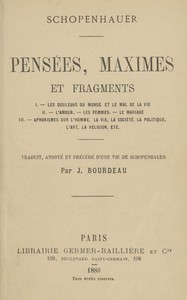
Pensées, maximes et fragments by Arthur Schopenhauer
Let's be clear: this isn't a novel with a plot. You won't find heroes on a quest. Instead, 'Pensées, Maximes et Fragments' is a door into the mind of Arthur Schopenhauer, the 19th-century philosopher famous for his pessimism. Think of it as his intellectual scrapbook. It's filled with short, sharp observations he jotted down over his lifetime, organized into themes like existence, art, women, books, and human nature.
The Story
There's no traditional story. The 'journey' is through Schopenhauer's uncompromising worldview. He builds his case piece by piece, aphorism by aphorism. He starts from a core idea: the world is driven by a blind, ceaseless 'Will'—a force of wanting and striving that causes all our pain. Everything else, from our daily anxieties to the structure of society, flows from this. He dissects vanity, the folly of public opinion, the consolations of art and music, and the quiet dignity of solitude. It's not a linear argument but a mosaic of insights that together form a coherent, if deeply dark, picture of life.
Why You Should Read It
I'll be honest: Schopenhauer is not for cheering you up on a bad day. But he is for making you feel seen on a bad day. There's a strange comfort in his honesty. When he writes about suffering being the default state, it's not to depress you, but to remove the pressure of constant, forced happiness. His thoughts on art and music as temporary escapes from the grind of desire are beautiful. Reading him feels like a mental detox from platitudes. He's witty, scathing, and often hilarious in his contempt for foolishness. You might disagree with him (especially on his views about women, which are notoriously awful), but you'll never find him boring or dishonest.
Final Verdict
This book is perfect for the curious skeptic, the introvert who needs ammunition against small talk, or anyone who loves a beautifully crafted, provocative idea. It's for readers who enjoy Christopher Hitchens, or who find dark humor in shows like 'True Detective' (season one). Don't go in looking for answers or hope. Go in looking for a brutally clear mirror held up to human existence, held by one of history's sharpest minds. It's a book to argue with, to underline, and to return to when the world's cheerful noise becomes too much to bear.
This content is free to share and distribute. You can copy, modify, and distribute it freely.
George Allen
8 months agoWithout a doubt, the narrative structure is incredibly compelling. Don't hesitate to start reading.
Lisa Sanchez
1 year agoJust what I was looking for.
Sandra Hernandez
1 year agoThis book was worth my time since the author's voice is distinct and makes complex topics easy to digest. Worth every second.
Michael Torres
9 months agoWithout a doubt, the atmosphere created is totally immersive. A true masterpiece.


Karen Garcia
11 months agoAfter hearing about this author multiple times, the author's voice is distinct and makes complex topics easy to digest. Exceeded all my expectations.