
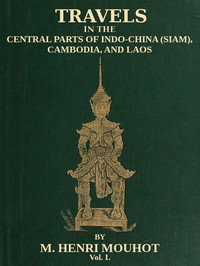
Travels in the Central Parts of Indo-China (Siam), Cambodia, and Laos (Vol.…
The Story
This book is Henri Mouhot's personal journal from his travels between 1858 and 1861. He wasn't a treasure hunter, but a scientist collecting plant and animal specimens. The story follows his grueling journey by elephant and boat from Bangkok into the dense interiors of Siam (Thailand), Cambodia, and Laos.
We feel his exhaustion from the heat and his battles with malaria. We see the stunning landscapes and vibrant cultures through his detailed notes. The plot twist, which even Mouhot didn't see coming, happens when his local guides lead him to a ruinous complex in the Cambodian jungle. He walks into Angkor Wat and the surrounding temples, which were largely unknown in Europe at the time. His vivid descriptions of these gigantic, beautiful structures being slowly reclaimed by tree roots became a sensation. The story ends not with a neat conclusion, but with Mouhot's death from fever in Laos, leaving his journals to tell the tale of his incredible find.
Why You Should Read It
You should read this because it captures a pure, unfiltered moment of discovery. Mouhot doesn't have all the answers about Angkor; he's just as awestruck as we are. His writing is personal. He complains about the bugs, admires the kindness of villagers, and sketches everything he sees with words.
It's the human experience of exploration that shines. This isn't a dry history book. It's a man risking everything for curiosity, and his reward is witnessing one of the world's great wonders. Reading his first reaction to Angkor Wat—the scale, the artistry, the haunting silence—is genuinely thrilling. It reminds you how much mystery our planet still held, even in the 19th century.
Final Verdict
This book is perfect for armchair adventurers, history lovers who want a primary source, and anyone who enjoys real-life stories more incredible than fiction. If you liked the feel of books like 'The Lost City of Z' or the idea of stumbling upon a hidden world, you'll be hooked. Be prepared for the slower, journal-style pacing, but stick with it. The payoff—that moment he describes the temples—is absolutely worth the journey. It's a foundational text for anyone fascinated by Angkor and a timeless snapshot of exploration at its most raw and inspiring.
Legal analysis indicates this work is in the public domain. Thank you for supporting open literature.
Mary Torres
1 year agoBased on the summary, I decided to read it and the narrative structure is incredibly compelling. Definitely a 5-star read.
Andrew Hill
1 year agoI came across this while browsing and the pacing is just right, keeping you engaged. I learned so much from this.
Aiden Johnson
1 year agoA bit long but worth it.
Christopher Martinez
1 year agoClear and concise.





Thomas Torres
4 months agoI had low expectations initially, however the character development leaves a lasting impact. Definitely a 5-star read.