Common Speaking Mistake: ‘I am agree’ Explained
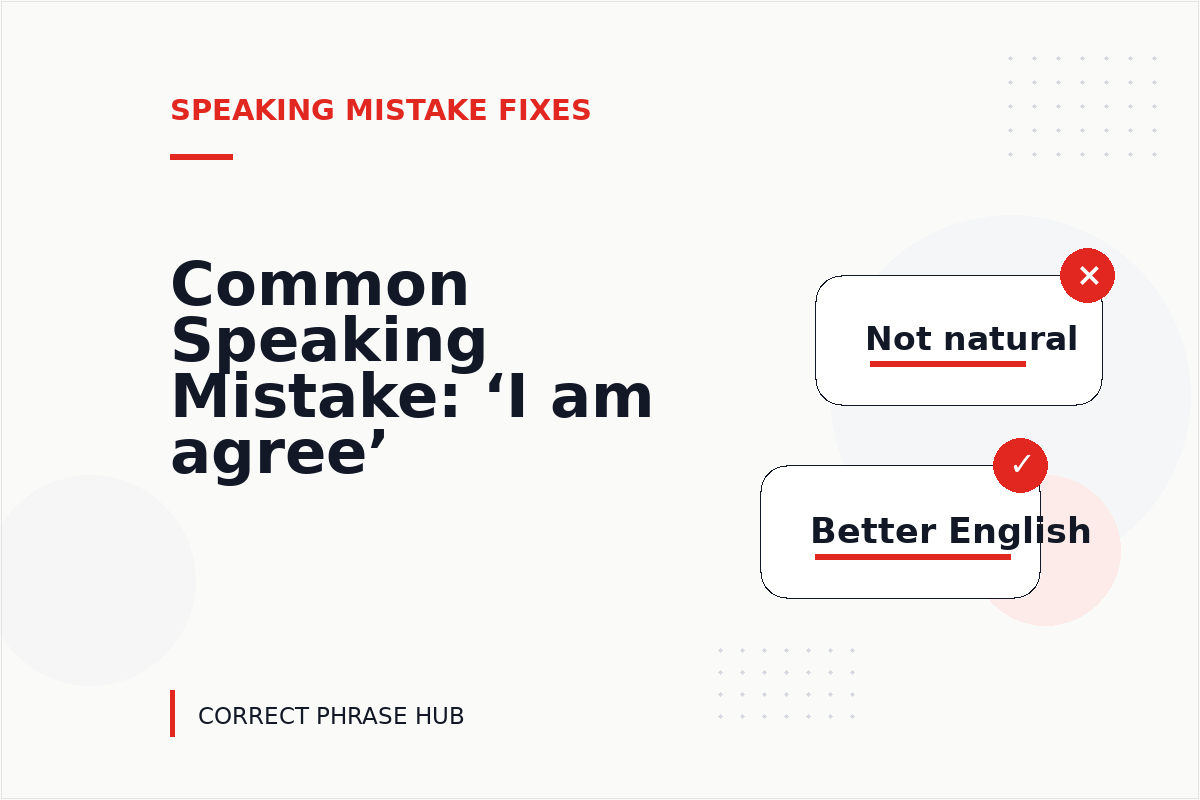
If you have ever said “I am agree” in an English conversation, you have made a very common speaking mistake. The direct answer is: “I am agree” is always grammatically incorrect. The correct phrase is “I agree.” The verb “agree” does not need the helping verb “am” because it is a simple present tense action verb, not an adjective. This guide will explain why this error happens, how to fix it, and give you the tools to use “agree” naturally in any situation.
Quick Answer: What Should You Say Instead?
If you want to express that you share the same opinion as someone else, use one of these correct forms:
- I agree. (Simple present – most common)
- I agree with you. (Adds the person you agree with)
- I agree to the plan. (Adds the thing you agree to)
- I am in agreement. (Formal, but uses the noun “agreement”)
Never use “am” directly before “agree.” The verb “agree” stands alone.
Why Do Learners Say ‘I am agree’?
This mistake often comes from direct translation. In many languages, the verb “to agree” is expressed as a state, similar to an adjective. For example, in Spanish, “Estoy de acuerdo” literally translates to “I am of agreement.” In French, “Je suis d’accord” means “I am in agreement.” Learners naturally carry this structure into English, but English treats “agree” as a standard action verb.
Think of it like the verb “to run.” You would never say “I am run.” You say “I run.” The same rule applies to “agree.”
Formal vs. Informal Use of ‘Agree’
Understanding the tone of “agree” helps you use it correctly in different contexts.
Informal Conversation
In everyday talk with friends or colleagues, keep it short and natural.
- Correct: “I totally agree. That movie was amazing.”
- Correct: “Yeah, I agree. Let’s go there.”
- Incorrect: “I am agree. That movie was amazing.”
Formal Writing and Email
In professional or formal settings, you can use “agree” directly, or use the noun form for a more polished tone.
- Correct: “I agree with the proposed changes to the contract.”
- Correct: “We are in full agreement on this matter.” (Formal)
- Incorrect: “I am agree with the proposed changes.”
Email Context
When writing an email, clarity is key. Use “agree” as a verb.
- Subject: Meeting Time
Body: “Thank you for the suggestion. I agree that 3 PM works best for everyone.” - Subject: Project Update
Body: “I agree with your assessment. We should move forward.”
Comparison Table: ‘I am agree’ vs. Correct Forms
| Incorrect Phrase | Correct Phrase | Context | Why It Works |
|---|---|---|---|
| I am agree. | I agree. | General conversation | “Agree” is a verb, not an adjective. |
| I am agree with you. | I agree with you. | Agreeing with a person | “With” follows the verb “agree.” |
| I am agree to the terms. | I agree to the terms. | Accepting conditions | “To” follows the verb “agree.” |
| I am agree that it is hard. | I agree that it is hard. | Agreeing with a statement | “That” clause follows the verb. |
| I am agree on the price. | I agree on the price. | Reaching a mutual decision | “On” follows the verb “agree.” |
Natural Examples of ‘I agree’ in Real Life
Here are examples that show how native speakers use “agree” in daily situations.
- At work: “I agree with Sarah’s idea for the marketing campaign. It targets the right audience.”
- With friends: “I agree, this pizza is the best in town.”
- In a meeting: “We all agree that the deadline needs to be extended.”
- In a discussion: “I agree to a certain extent, but we also need to consider the budget.”
- On the phone: “Yes, I agree. Let’s confirm the booking for Friday.”
Common Mistakes with ‘Agree’
Beyond “I am agree,” learners often make other errors with this verb. Here are the most frequent ones.
Mistake 1: Using ‘Agree’ with ‘To’ Incorrectly
- Incorrect: “I agree to you.”
- Correct: “I agree with you.” (Use “with” for people.)
- Correct: “I agree to the proposal.” (Use “to” for things like plans or ideas.)
Mistake 2: Forgetting the Preposition
- Incorrect: “I agree you.”
- Correct: “I agree with you.”
Mistake 3: Using ‘Agree’ as an Adjective
- Incorrect: “I am very agree.”
- Correct: “I strongly agree.” (Use an adverb like “strongly” or “completely.”)
Mistake 4: Confusing ‘Agree’ with ‘Accept’
- Incorrect: “I agree the gift.”
- Correct: “I accept the gift.” (Use “accept” when receiving something.)
- Correct: “I agree to accept the gift.” (This means you consent to receiving it.)
Better Alternatives to ‘I agree’
Sometimes you want to vary your language. Here are natural alternatives to “I agree” for different situations.
Informal Alternatives
- “You’re right.” – Simple and direct.
- “That’s true.” – Confirms a fact.
- “Exactly.” – Shows strong agreement.
- “No doubt.” – Casual and confident.
Formal Alternatives
- “I concur.” – Very formal, often used in writing.
- “That is correct.” – Professional and clear.
- “We are of the same mind.” – Formal and collaborative.
- “I share your view.” – Polite and respectful.
When to Use ‘I am in agreement’
The phrase “I am in agreement” is grammatically correct but formal. Use it in official documents, speeches, or very polite emails. For example: “I am in agreement with the board’s decision.” In everyday conversation, stick with “I agree.”
Mini Practice: Test Your Understanding
Choose the correct option for each sentence. Answers are below.
1. Which sentence is correct?
A. I am agree with the new policy.
B. I agree with the new policy.
C. I am agreeing with the new policy.
2. Fill in the blank: She __________ the terms of the contract.
A. agrees to
B. is agree to
C. agree to
3. Choose the best option for a formal email:
A. I am agree with your suggestion.
B. I agree with your suggestion.
C. I am in agreement with your suggestion.
4. Which sentence is incorrect?
A. I agree on the price.
B. I agree with you.
C. I am agree that it is late.
Answers
1. B – “I agree with the new policy” is correct. “I am agreeing” could work in a continuous tense context, but it is less common for a simple opinion.
2. A – “She agrees to the terms” is correct. “Agrees” is the third-person singular form.
3. C – “I am in agreement with your suggestion” is the most formal and appropriate for a formal email. Option B is also correct but less formal.
4. C – “I am agree that it is late” is incorrect. The correct form is “I agree that it is late.”
Frequently Asked Questions
1. Is ‘I am agreeing’ ever correct?
Yes, but only in the present continuous tense. For example: “I am agreeing to the terms as we speak.” This is rare and usually used to describe an action happening right now. For general opinions, use “I agree.”
2. Can I say ‘I am agreed’?
No. “Agreed” is the past tense or past participle. You can say “I agreed” (past tense) or “We are agreed” (very formal, meaning we have reached an agreement). But “I am agreed” alone is incorrect.
3. What is the difference between ‘agree with’ and ‘agree to’?
“Agree with” is used for people or opinions. Example: “I agree with you.” “Agree to” is used for plans, proposals, or actions. Example: “I agree to the schedule.”
4. How do I correct someone who says ‘I am agree’?
Politely say: “In English, we say ‘I agree’ without ‘am.’ It is a common mistake, but now you know the correct form.” You can also show them this guide for a clear explanation.
Final Tip for Speaking Naturally
To make “I agree” sound natural, practice using it in full sentences. Instead of just saying “I agree,” add a reason or a follow-up. For example: “I agree with you because the data supports that conclusion.” This makes your English sound more fluent and confident. Avoid the “am” trap, and you will speak more accurately every time.
For more help with common speaking errors, explore our Speaking Mistake Fixes section. If you have questions about this guide, visit our FAQ page or contact us. We also recommend checking our Editorial Policy to understand how we create accurate content.