
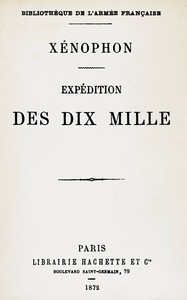
Expédition des dix mille by Xenophon
So, what's this ancient book actually about? Let's break it down.
The Story
A Greek army of 10,000 mercenaries is hired by Cyrus, a Persian prince, to help him take the throne from his brother, the King of Persia. They march deep into what is now Iraq. At a huge battle, Cyrus is killed. Suddenly, the Greeks are on their own. Their generals are tricked and murdered by the Persians. Stranded and leaderless, with hostile forces all around, they elect new leaders. One of them is Xenophon, the author, an Athenian who wasn't even a soldier when he started. His job? Get everyone home. The rest of the book is their grueling, year-long trek north through Armenian snows, Kurdish mountains, and along the Black Sea coast. It's a story of constant crisis: finding food, fighting off attacks, navigating frozen rivers, and dealing with internal doubt. The famous moment comes when the advance guard finally crests a ridge and shouts, 'Thalassa! Thalassa!' ('The sea! The sea!')—seeing the Black Sea meant a path back to Greece.
Why You Should Read It
You read this not for poetic language, but for its breathtaking immediacy. Xenophon isn't a historian looking back; he's writing a memoir of pure, desperate problem-solving. You feel the panic when the generals are killed and the clever, practical decisions that follow. How do you cross a river in winter? How do you motivate starving men? The book becomes a masterclass in pragmatic leadership. Xenophon isn't a flawless hero; he argues, makes mistakes, and has to rally spirits constantly. It strips away the myth of ancient warfare and shows the gritty, human reality: cold, hunger, and the sheer will to survive. It’s profoundly relatable because it's about a group of people in an awful situation, figuring it out one day at a time.
Final Verdict
This is a perfect pick for anyone who loves true adventure stories, military history, or leadership case studies. If you enjoyed 'Endurance' by Alfred Lansing (the Shackleton story), you'll find the same spirit here, but 2,300 years earlier. It's also surprisingly accessible—the action moves fast. You don't need to be a classics scholar. Just be ready for a story that feels less like a dusty old text and more like sitting with a veteran who's telling you, 'So, here's how we got out of that mess...' It's a foundational adventure tale that has inspired countless others, and for good reason.
Legal analysis indicates this work is in the public domain. You do not need permission to reproduce this work.
Paul Smith
1 year agoTo be perfectly clear, the narrative structure is incredibly compelling. Truly inspiring.
Joshua Wilson
1 year agoFrom the very first page, the atmosphere created is totally immersive. Exceeded all my expectations.
Michael King
2 years agoAfter hearing about this author multiple times, it manages to explain difficult concepts in plain English. Worth every second.
Lucas Moore
3 months agoGreat read!





Donna Martin
1 year agoI came across this while browsing and the atmosphere created is totally immersive. I learned so much from this.