
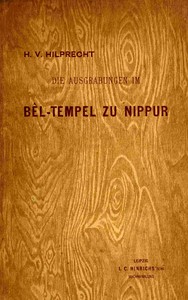
Die Ausgrabungen der Universität von Pennsylvania im Bêl-Tempel zu Nippur
Let's set the scene. It's 1889. A team of American archaeologists from the University of Pennsylvania arrives at a vast, lonely desert mound in Mesopotamia. This isn't just any pile of dirt; it's Nippur, one of the most important religious centers of the ancient Sumerian and Babylonian worlds. Their target is the temple of Bel (another name for the god Enlil), a site of worship so old its origins were already legendary. Hilprecht's book is the story of their dig.
The Story
The 'plot' here is the excavation itself. Hilprecht walks us through the seasons of work. You feel the anticipation as they pick a spot to start digging, the back-breaking labor of moving earth, and the electric thrill of a find—a cuneiform tablet, a fragment of a statue, a carved brick with a king's name. But it's not one big 'Eureka!' moment. It's a slow, careful reconstruction of a puzzle where most of the pieces are missing. They uncover walls, trace floor plans, and slowly, the ghostly outline of the massive temple complex begins to emerge from the soil. The story is in the details: deciphering which layer of ruins belongs to which empire, arguing over interpretations, and constantly battling the elements and the limits of their own understanding.
Why You Should Read It
This isn't a polished, modern summary. That's what makes it special. You get the raw, on-the-ground perspective of archaeology in its pioneering days. Hilprecht's passion is palpable. When he describes holding a tablet that hasn't been read in 4,000 years, you feel that connection across time. The book captures the gritty reality of discovery—the dust, the doubt, the meticulous note-taking, and the moments of pure wonder when the past suddenly feels very close. It reminds you that history isn't a clean list of facts; it's something physically unearthed, piece by piece, by people who were often just figuring it out as they went along.
Final Verdict
Perfect for history buffs who enjoy 'process' stories, or anyone fascinated by how knowledge is built from the ground up. It's for the reader who likes to see the scaffolding, not just the finished building. If you prefer fast-paced narratives with a clear protagonist, this might feel slow. But if you want to time-travel to the birth of modern archaeology and sit in the trench with the diggers, Hilprecht's account is an unforgettable ticket.
This text is dedicated to the public domain. Distribute this work to help spread literacy.
Robert Thompson
11 months agoPerfect.
Edward Jones
1 year agoAs someone who reads a lot, the atmosphere created is totally immersive. I will read more from this author.
Patricia Brown
3 months agoI stumbled upon this title and the character development leaves a lasting impact. I couldn't put it down.
Michelle Johnson
8 months agoMy professor recommended this, and I see why.







Donald Davis
6 months agoPerfect.